


Have you ever noticed how certain experiences seem to stay with you, even years after they’ve happened?
Perhaps a particular sound makes your heart race. A disagreement leaves you feeling unexpectedly overwhelmed. You find yourself repeating the same relationship patterns, struggling with self-doubt, or reacting to situations in ways you don’t fully understand.
You may know intellectually that you’re safe, yet your body responds as though something threatening is happening right now.
This is one of the ways unresolved trauma can affect us. And it’s one reason Eye Movement Desensitization and Reprocessing (EMDR) therapy can be so helpful.
EMDR is an evidence-based psychotherapy that helps people process distressing experiences, reduce the emotional intensity of traumatic memories, and develop healthier beliefs about themselves.
Unlike some traditional forms of talk therapy, EMDR doesn’t require you to repeatedly describe every painful detail of your experiences.
Instead, it offers a structured approach to helping your mind and body respond differently to memories that have continued to affect your life.

What Is EMDR Therapy?
EMDR stands for Eye Movement Desensitization and Reprocessing.
Developed by psychologist Dr. Francine Shapiro in the late 1980s, EMDR was originally designed to help people experiencing post-traumatic stress disorder (PTSD).
Today, EMDR is recognized as an effective treatment for PTSD by leading organizations, including the U.S. Department of Veterans Affairs and the World Health Organization.
But you don’t necessarily need a PTSD diagnosis to explore whether EMDR could benefit you.
Therapists also use EMDR to address distressing experiences associated with anxiety, grief, negative self-beliefs, relationship difficulties, and other emotional challenges. The scientific evidence is strongest for PTSD, and effectiveness for other conditions varies.
At its heart, EMDR is based on a powerful idea:
An experience from your past does not have to continue determining how you feel about yourself in the present.
How Does EMDR Therapy Work?
Our brains are constantly processing experiences, helping us learn, adapt, and make sense of the world.
When something difficult happens, we can often reflect on the experience, integrate what we’ve learned, and move forward.
But overwhelming or traumatic experiences can be different.
When we encounter something frightening, threatening, or emotionally overwhelming, our stress-response systems become highly activated.
Sometimes, reminders of these experiences continue to trigger intense emotions, uncomfortable physical sensations, or negative beliefs long after the event has ended.
For example, someone who experienced repeated criticism during childhood might develop the belief:
“I’m not good enough.”
Even as a successful adult, that belief may continue influencing relationships, professional decisions, and self-worth.
EMDR helps people revisit and process experiences connected to these reactions while remaining grounded in the present.
The Role of Bilateral Stimulation
One of EMDR’s distinctive features is something called bilateral stimulation.
This involves alternating attention or sensory input from one side to the other, often through:
- Following a therapist’s fingers or a moving visual target with your eyes
- Alternating gentle taps
- Listening to sounds that alternate between the left and right ears
During portions of EMDR therapy, you briefly bring a distressing memory to mind while engaging in bilateral stimulation.
The goal is to help you process the memory so it becomes less emotionally overwhelming.
Researchers are still studying exactly how EMDR works. One explanation involves the demands placed on working memory when recalling an upsetting experience while simultaneously performing another task.
What matters clinically is that research has demonstrated meaningful reductions in symptoms for many people who receive EMDR.
How Does Trauma Affect the Brain and Nervous System?
Trauma doesn’t always announce itself through obvious flashbacks or nightmares.
Sometimes it appears in more subtle ways.
You might notice that you:
- Feel anxious even when nothing seems wrong
- Become overwhelmed by conflict or criticism
- Have difficulty trusting others
- Experience chronic tension or heightened alertness
- Struggle with feelings of shame or inadequacy
- Shut down emotionally during stressful situations
- Find yourself repeating unhealthy relationship patterns
- Feel disconnected from your emotions or body
These experiences can involve the interaction of memory, emotional regulation, and the body’s stress-response systems.
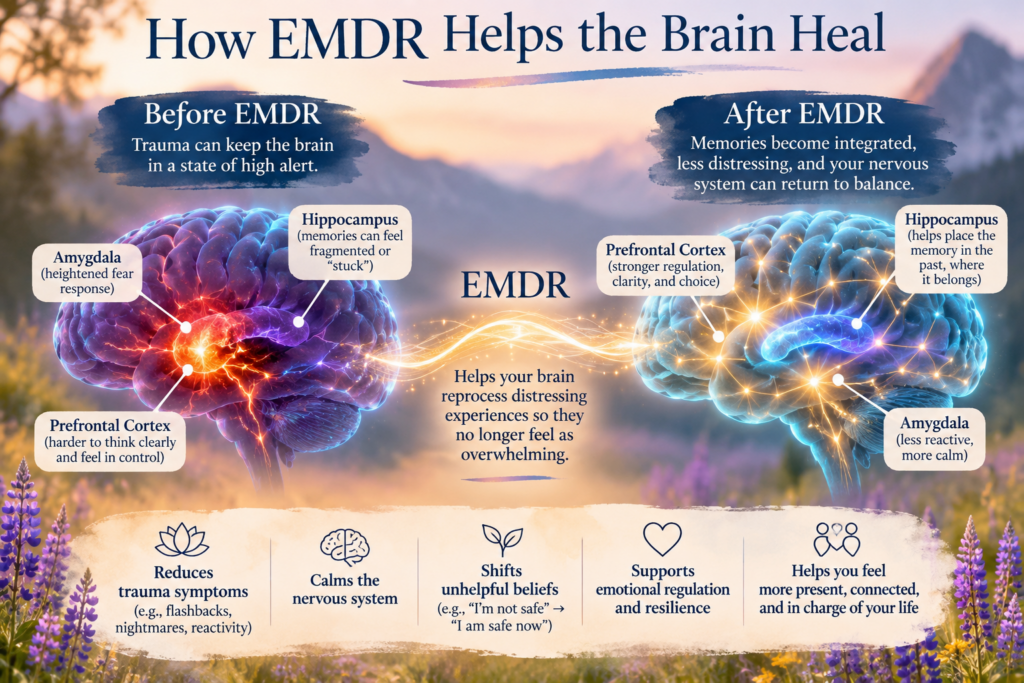
Three important brain regions are frequently discussed in trauma research:
The amygdala: Helps detect potential threats and contributes to emotional and fear-related responses.
The hippocampus: Plays an important role in memory and helps organize experiences within a broader context of time and place.
The prefrontal cortex: Supports planning, decision-making, attention, and regulation of emotional responses.
Trauma-related stress can influence how these systems communicate and respond.
This helps explain why someone might logically understand that a situation is safe but still experience an intense emotional or physical reaction.
EMDR aims to reduce the distress associated with traumatic memories and the triggers connected to them.
It does not erase memories. Rather, it can change how strongly those memories affect you.
What Happens During an EMDR Therapy Session?
One of the most common concerns people have about EMDR is whether they’ll have to immediately revisit painful memories.
The answer is no. EMDR is a carefully structured process, and preparation is an essential part of treatment.
EMDR therapy includes eight phases, although not every phase occurs during every session.
1. Understanding Your History
Your therapist takes time to understand your experiences, current challenges, strengths, and goals.
Together, you’ll explore how earlier experiences may relate to present-day difficulties.
2. Building Safety and Emotional Resources
Before beginning trauma processing, your therapist helps you develop ways to manage emotional distress.
This may include grounding exercises, mindfulness, breathing techniques, visualization, or other strategies that support emotional regulation.
For individuals with complex trauma, this preparation phase may take additional time.
3. Identifying a Memory to Process
Together, you’ll identify a particular memory or experience connected to your current distress.
Your therapist will help you notice the emotions, beliefs, images, and physical sensations associated with it.
4. Reprocessing the Experience
You’ll briefly focus on aspects of the memory while engaging in bilateral stimulation.
Your therapist guides the process, checking in regularly about what you’re noticing.
Thoughts, feelings, sensations, and associations may change as processing continues.
5. Strengthening Healthier Beliefs
As the memory becomes less distressing, you’ll work toward developing a more adaptive belief about yourself.
For example:
“I am powerless” may shift toward “I have choices now.”
Or:
“It was my fault” may become “I was not responsible for what happened.”
6. Noticing the Body
Your therapist helps you identify whether any uncomfortable physical sensations remain connected to the memory.
7. Ending the Session Safely
Each session includes time for closure, grounding, and returning attention to the present.
8. Reviewing Your Progress
In subsequent sessions, you’ll revisit your progress and determine what additional work may be helpful.
The process is collaborative, and you remain an active participant throughout treatment.
What Are the Benefits of EMDR Therapy?
For many people, the benefits of EMDR extend beyond simply feeling less distressed when remembering a traumatic experience.
Depending on your history, symptoms, and treatment goals, EMDR may help with:
Reducing Trauma Symptoms
EMDR can reduce PTSD symptoms such as intrusive memories, nightmares, avoidance, and heightened reactivity.
Changing Negative Self-Beliefs
Traumatic experiences can leave people carrying painful beliefs about themselves.
EMDR may help loosen the emotional hold of beliefs such as:
- I’m not safe.
- I’m not lovable.
- I’m not good enough.
- I can’t trust myself.
- I have no control.
Improving Emotional Regulation
As trauma-related distress decreases, some people find it easier to respond to challenging situations without becoming overwhelmed.
Supporting Healthier Relationships
When past experiences no longer trigger the same level of fear or emotional intensity, it may become easier to establish boundaries, communicate needs, and build trust.
Reducing Trauma-Related Physical Distress
Emotional distress and physical sensations are closely connected.
Some people experience reduced tension or other stress-related bodily reactions as their traumatic memories become less upsetting.
Developing a Greater Sense of Self-Compassion
Perhaps one of the most meaningful changes is learning to see yourself through a different lens.
Instead of defining yourself by what happened to you, you may begin recognizing your resilience, choices, and capacity for growth.
Can EMDR Help With Childhood Trauma and Attachment Wounds?
Not all trauma comes from a single frightening event.
Sometimes emotional wounds develop gradually through experiences such as:
- Growing up with unpredictable caregivers
- Experiencing emotional neglect
- Feeling responsible for other people’s emotions
- Living with chronic criticism or rejection
- Experiencing abandonment or betrayal
- Having to suppress your own needs to maintain relationships
These experiences can shape how we understand safety, connection, and self-worth.
For example, a child who learns that expressing emotions leads to rejection may become an adult who struggles to communicate their needs.
An attachment-informed approach to EMDR considers how early relationships may influence present-day beliefs and emotional reactions.
Therapy may involve exploring these connections, strengthening emotional resources, and carefully processing relevant memories.
The goal isn’t to blame caregivers or rewrite the past.
It’s to help you understand how earlier experiences may be influencing your life today—and discover new ways of responding.
Do You Have to Talk About Your Trauma During EMDR?
This is one of the most reassuring aspects of EMDR for many clients.
You generally do not have to describe every detail of your traumatic experience out loud.
Your therapist will need enough information to understand your concerns, assess your needs, and guide treatment safely.
However, much of the memory processing can occur without an extensive verbal retelling.
This can be particularly helpful for people who find it difficult to put their experiences into words.
You also have a voice in the pace of treatment. A qualified EMDR therapist should work collaboratively with you, monitor your responses, and adjust treatment when necessary.
How Long Does EMDR Therapy Take?
There isn’t one universal timeline for EMDR therapy.
Some individuals working through a single traumatic event may notice improvement within a relatively short course of treatment.
Others, particularly those with longstanding or complex trauma histories, may benefit from a longer period of therapy.
Research on PTSD often examines approximately three months of weekly treatment, although individual needs vary considerably.
Factors that influence treatment length include your history, current symptoms, available support, readiness for memory processing, and therapeutic goals.
Healing isn’t a competition, and faster doesn’t always mean better.
Is EMDR Therapy Safe?
EMDR is an established, evidence-based treatment when provided by an appropriately trained mental health professional.
However, processing traumatic memories can temporarily increase emotional distress, bring up unexpected memories, or lead to vivid dreams and fatigue.
This is why careful assessment, preparation, pacing, and ongoing communication are important.
Individuals experiencing significant dissociation, active safety concerns, or other complex mental health challenges may need additional stabilization or a modified treatment approach.
EMDR isn’t the right choice for every person at every moment.
A qualified therapist can help determine whether it fits your needs.
Can EMDR Therapy Be Done Online?
Yes. EMDR can be provided through secure telehealth sessions.
Instead of following a therapist’s hand in an office, clients may use visual tools on a screen, alternating sounds, or guided tapping.
Online EMDR follows the same general eight-phase treatment framework, with adjustments for the virtual setting.
Telehealth can be particularly helpful for people who have transportation difficulties, live in rural communities, or prefer receiving therapy from the comfort of home.
Your therapist should assess whether virtual EMDR is appropriate for your circumstances and establish a plan for managing distress during sessions.
Although emerging evidence supports online delivery, the research base is less extensive than for in-person EMDR.
Frequently Asked Questions About EMDR Therapy
Does EMDR erase traumatic memories?
No. EMDR does not erase memories or change what happened. Its goal is to reduce the emotional distress associated with those memories so they no longer affect you in the same way.
Is EMDR the same as hypnosis?
No. EMDR is not hypnosis. You remain awake, aware, and actively involved in the therapeutic process.
Can EMDR help with anxiety?
EMDR may help when anxiety is connected to distressing memories or earlier experiences. However, the evidence for treating anxiety disorders is less established than the evidence for PTSD.
Does EMDR work for complex PTSD?
EMDR may be helpful for people with complex trauma histories, but treatment often requires individualized planning, careful pacing, and attention to emotional regulation and dissociation.
Can EMDR help if I don’t remember my childhood clearly?
Yes! A complete chronological memory of childhood isn’t always necessary for therapy. A qualified therapist can assess whether EMDR is appropriate and determine which experiences or current reactions might be useful to address.
Will EMDR make me relive my trauma?
EMDR involves briefly bringing distressing material to mind, which can be uncomfortable. However, the goal is not to force you to relive an experience. Your therapist should help you remain oriented to the present and adjust the process according to your needs.
How do I know if EMDR is right for me?
A consultation or initial assessment with a trained EMDR therapist can help you explore your symptoms, treatment goals, and whether EMDR is an appropriate option.

Healing Doesn’t Mean Forgetting What Happened
One of the most important things I want people to understand about trauma recovery is that healing doesn’t require pretending the past never happened.
It doesn’t mean minimizing your experiences or forcing yourself to forgive someone who hurt you.
Healing can mean remembering what happened without experiencing the same overwhelming fear, shame, or helplessness.
It can mean recognizing that the beliefs you developed during painful experiences don’t have to define who you are today.
And it can mean developing a greater sense of safety, connection, and choice in your everyday life.
Your past is part of your story, but it doesn’t have to write every chapter of your future.
Explore EMDR Therapy in Washington State
I’m Shanie Matthews, a Licensed Mental Health Counselor Associate (LMHCA) with certification in EMDR, somatic approaches, mindfulness, and attachment-informed therapy.
My approach recognizes that emotional healing involves more than understanding our thoughts. It also includes learning to recognize and respond to the ways stress and difficult experiences affect our bodies, relationships, and sense of self.
I believe therapy should be collaborative, compassionate, and tailored to your individual needs.
I offer online therapy to clients throughout Washington State through Talk. Heal. Thrive.
If you’re struggling with unresolved trauma, difficult relationship patterns, or painful beliefs about yourself, you don’t have to navigate those experiences alone.
Ready to explore whether EMDR therapy might help you?
Learn more about my approach and schedule an appointment.
Insurance is accepted, with coverage depending on your plan and provider credentialing.
Research and Further Reading
If you’d like to learn more about the research behind EMDR, these reputable resources offer additional information:
- U.S. Department of Veterans Affairs — National Center for PTSD. Eye Movement Desensitization and Reprocessing (EMDR) for PTSD.
https://www.ptsd.va.gov/understand_tx/emdr.asp - U.S. Department of Veterans Affairs — National Center for PTSD. Eye Movement Desensitization and Reprocessing for PTSD: Professional Overview.
https://www.ptsd.va.gov/professional/treat/txessentials/emdr_pro.asp - EMDR International Association (EMDRIA). Experiencing EMDR Therapy: The Eight Phases.
https://www.emdria.org/about-emdr-therapy/experiencing-emdr-therapy/ - U.S. Department of Veterans Affairs — National Center for PTSD. Overview of Psychotherapy for PTSD.
https://www.ptsd.va.gov/professional/treat/txessentials/overview_therapy.asp
Disclaimer: This article is intended for educational purposes and is not a substitute for individualized mental health assessment, diagnosis, or treatment.










+ show Comments
- Hide Comments
add a comment